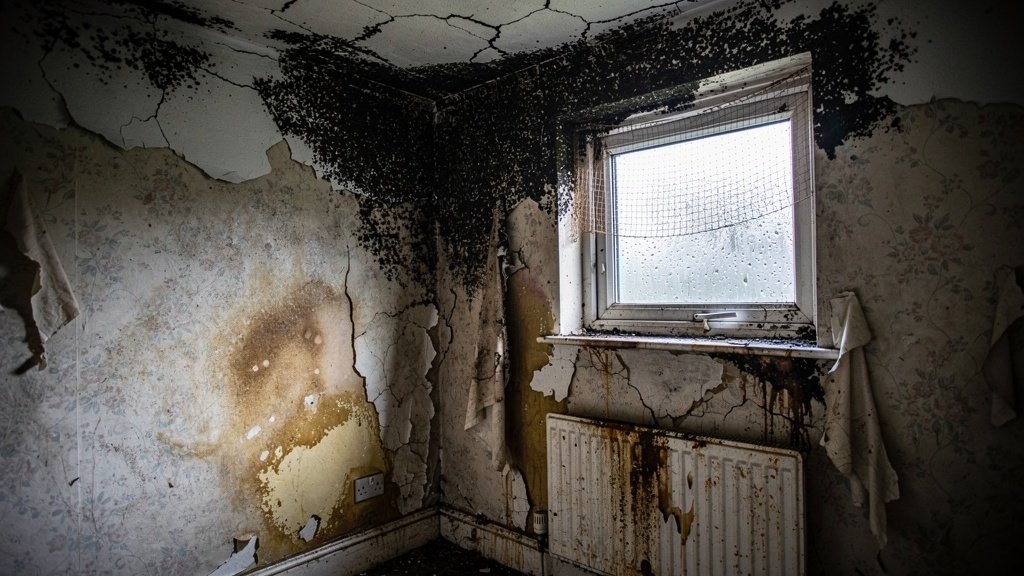
Damp is one of the most common — and most misunderstood — problems in UK housing. At Disrepair Claim Surveyors, we carry out hundreds of housing disrepair surveys every year, and damp is present in a significant proportion of them. Yet there is a great deal of confusion among tenants, landlords and even some builders about the different types of damp, their causes and how they should be treated.
Getting the diagnosis right matters enormously. The wrong treatment is a waste of money — and in a housing disrepair claim, misidentifying the cause of damp can undermine your entire case. In this guide, we explain the key differences between rising damp and penetrating damp, how our surveyors diagnose each type, and what the correct remedial action looks like.
Disrepair Claim Surveyors and Damp Diagnosis
Diagnosing damp correctly requires specialist training, professional equipment and genuine experience. A damp-proof company sales representative has a commercial incentive to identify the most expensive problem. A properly accredited disrepair surveyor from our team, by contrast, has no such incentive — our role is to identify the true cause of the problem and report it objectively.
We use a combination of moisture meters, thermal imaging cameras, hygrometers and careful visual inspection to diagnose damp accurately. Our written reports clearly state the type of damp identified, its likely cause, the extent of the affected area, and what remedial works are required.
What Is Rising Damp?
Rising damp is moisture that travels upward through the porous material of a wall from the ground. It occurs because of capillary action — the same physical principle that causes liquid to travel up a narrow tube. In a wall, water from the ground is drawn up through the tiny pores in brickwork and mortar.
In most post-war properties, rising damp is prevented by a damp-proof course (DPC) — a horizontal barrier of impermeable material (such as slate, engineering brick, bitumen felt or chemical injection) installed at low level in the wall. When this barrier is absent, damaged, bridged or absent, rising damp can develop.
How to Recognise Rising Damp
Rising damp has several distinctive characteristics that an experienced surveyor will look for:
- A "tide mark" on the wall — a horizontal staining line, usually between 0.5 and 1.5 metres above floor level, beyond which the wall is dry. This is caused by salts deposited as moisture evaporates.
- Efflorescence — white, powdery salt deposits on the surface of the wall, left behind as water evaporates and draws salts from the masonry.
- Deteriorating plaster — plaster at low level may be crumbling, soft or hollow-sounding because of the crystalline salts forming within it.
- Staining and discolouration — brown or yellowish staining on walls and skirting boards.
- Damp skirting boards and floor coverings — rising moisture can penetrate floor materials and cause rot in timber skirtings.
- Musty smell — a distinctive earthy, musty odour associated with damp masonry.
Crucially, rising damp does not typically extend above 1.0–1.5 metres above floor level. If you see damp high on a wall or on a ceiling, rising damp is almost certainly not the cause.
Is True Rising Damp Common?
This is a somewhat controversial question in the surveying world. Some specialists argue that "true" rising damp — caused purely by capillary action through an absent or failed DPC — is less common than the damp-proofing industry suggests. Many cases diagnosed as rising damp are actually caused by other factors such as defective external render, bridged DPCs, high external ground levels, or condensation.
This is precisely why an independent, impartial survey by a qualified disrepair surveyor is so valuable. We will tell you what is actually causing the problem — not what generates the most expensive treatment.
What Is Penetrating Damp?
Penetrating damp is moisture that enters a building horizontally — through external walls, roofs, windows, chimneys or any other part of the building envelope. Unlike rising damp, it is not driven by capillary action from the ground. Instead, it is driven by rainfall, wind-driven rain, or plumbing leaks.
Penetrating damp is far more common than rising damp and can occur in properties of any age. It is particularly prevalent in older Victorian and Edwardian terraced housing — the housing stock most commonly associated with housing disrepair claims in the UK.
Common Causes of Penetrating Damp
- Defective or missing roof coverings — cracked, slipped or missing roof tiles, failed flashings, broken ridges or hips
- Failed or blocked gutters and downpipes — overflowing gutters allow water to saturate external walls
- Cracked or spalled external render and masonry — water enters through cracks and saturates the wall
- Defective window and door surrounds — failed pointing or sealant around frames allows water ingress
- Defective chimney stacks — failed chimney flashings, cracked chimney pots or eroded pointing allow rainwater to pour down internally
- Flat roof defects — blistered or cracked felt, failed seals at upstands and outlets
- Plumbing leaks — hidden leaks from pipes, radiators or appliances can mimic penetrating damp
- Cavity wall issues — displaced cavity wall insulation can bridge the cavity and carry moisture through to the inner leaf
How to Recognise Penetrating Damp
Penetrating damp presents differently depending on its source:
- Damp patches that appear during or after rain — a strong indicator that water is entering from outside
- Damp patches that follow the pattern of the external defect — for example, a damp patch below a window where the sill is failing, or a circular damp patch on a ceiling below a defective roof joint
- Damp at high level on walls or on ceilings — rising damp cannot cause this; penetrating damp can
- Damp on external walls in heavy rain but not during dry periods
- Visible mould growth — particularly where moisture has been present for an extended period
- Staining patterns — water tends to track along structural elements and create irregular staining patterns
What About Condensation?
A third type of moisture problem — condensation damp — is frequently confused with both rising and penetrating damp. Condensation occurs when warm, moist air contacts a cold surface (typically an external wall or window) and the moisture in the air deposits as water droplets.
Condensation is the most common form of dampness in UK homes. It typically presents as:
- Black mould growth on walls, window reveals and window frames
- Mould on soft furnishings — clothes, curtains, furniture against cold walls
- Streaming windows in the morning
- Damp patches in corners at ceiling level — cold bridges where heat loss is greatest
Condensation is sometimes caused or worsened by structural defects — inadequate insulation, failed double glazing, blocked ventilation — that a landlord is required to fix. In our dedicated guide on damp and mould, we explain how condensation interacts with housing disrepair law in detail.
How Our Surveyors Diagnose the Type of Damp
Accurate diagnosis requires a systematic approach. Our surveyors follow a structured inspection process:
1. External Inspection
We inspect the external envelope of the property to identify potential sources of water ingress — roofs, gutters, downpipes, render, pointing, window and door surrounds, chimney stacks and below-DPC ground levels. A significant proportion of damp problems can be traced to an external defect that is visible on inspection.
2. Internal Moisture Mapping
Using calibrated moisture meters, we map the moisture content of affected walls, floors and ceilings. This tells us the extent of moisture penetration and helps distinguish between the different types of damp based on the pattern of moisture distribution.
3. Thermal Imaging Survey
A thermal imaging camera reveals temperature differences across wall surfaces. Cold, damp areas show up as distinct colour patterns. Thermal imaging is particularly useful for identifying hidden damp — damp that is not yet visible to the naked eye — and for tracing the source of penetrating damp through structures.
4. Hygrothermal Assessment
We measure relative humidity and air temperature using a hygrometer to assess the condensation risk within each room. A high relative humidity combined with cold surfaces is a strong indicator of condensation as a contributing factor.
5. Salt Analysis (Where Required)
The presence of certain hygroscopic salts (particularly nitrates and chlorides) in plaster samples can confirm the presence of rising damp, since these salts are characteristic of groundwater. Where the diagnosis is uncertain, we may recommend laboratory analysis of plaster samples.
Why the Correct Diagnosis Matters for Your Disrepair Claim
In a housing disrepair claim, the type of damp matters because it affects which legal obligation your landlord has breached. For example:
- Penetrating damp from roof defects is clearly a breach of Section 11 of the Landlord and Tenant Act 1985, which requires landlords to keep the structure and exterior in repair
- Rising damp from a failed DPC is also a Section 11 issue — the DPC is part of the structure
- Condensation caused by inadequate insulation or ventilation may also engage Section 11 obligations, and will certainly engage the Homes (Fitness for Human Habitation) Act 2018 if it makes the property unfit
A vague or inaccurate diagnosis — "there's damp" — is much harder to litigate than a precisely documented technical assessment that identifies the specific defect, its cause and the appropriate remedy. This is why our reports are so highly regarded by housing disrepair solicitors across the UK.
Real Case Study: Diagnosis Saves the Day
A tenant in Manchester had been living with severe damp in her ground-floor bedroom for two years. Her landlord had twice arranged for a local damp-proofing company to inject a chemical DPC, at a cost of several hundred pounds. The damp kept coming back.
When she instructed Disrepair Claim Surveyors, our thorough inspection revealed the true cause: a blocked soil pipe behind the external wall of the property was leaking, saturating the subsoil and keeping the wall permanently damp. The repeated DPC treatments had been treating a symptom, not a cause. No amount of damp-proofing would solve a plumbing leak.
Armed with our report, the tenant's solicitor secured an order requiring the landlord to repair the plumbing and make good all affected internal finishes. The tenant also received compensation for two years of living in damp conditions.
Frequently Asked Questions
Can rising damp reach the first floor of a house?
In most cases, no. Rising damp driven by capillary action rarely exceeds 1.0–1.5 metres above floor level. Moisture above this height on a wall is almost certainly caused by penetrating damp, condensation or a plumbing leak — not rising damp.
Is my landlord responsible for all types of damp?
Your landlord is responsible for structural defects that cause or contribute to damp — failed roofs, blocked gutters, defective render, failed DPCs, plumbing leaks and inadequate ventilation. Condensation caused purely by the tenant's lifestyle (cooking, drying clothes indoors, insufficient heating) is less clear-cut legally, but where structural factors contribute, the landlord still has obligations.
How do I know if my damp is structural or lifestyle?
A professional survey is the only reliable way to determine this. Our surveyors are trained to distinguish between damp caused by structural defects and damp exacerbated by lifestyle factors. Many cases involve both elements — and a good survey report will address both fairly and accurately.
Does damp always cause mould?
Not always, but damp creates the conditions in which mould thrives. Mould requires moisture, warmth and an organic surface to grow on. Any persistent source of moisture — rising damp, penetrating damp or condensation — that is not resolved will typically lead to mould growth within weeks or months.
Can I get a survey if my landlord disputes the damp is their responsibility?
Absolutely — and this is one of the most common situations in which tenants commission our surveys. An independent, impartial technical report from Disrepair Claim Surveyors carries far more weight than the landlord's assertion that the problem is the tenant's fault. Our reports are regularly used as the primary evidence in disputed housing disrepair cases.
Get Your Damp Survey Today
Whether you are dealing with rising damp, penetrating damp, condensation or a combination of all three, Disrepair Claim Surveyors can provide the expert diagnosis you need. Our thorough, independent surveys give you a clear picture of what is causing the problem and what your landlord needs to do about it.
We work alongside housing disrepair solicitors across the UK and our reports are prepared to the highest professional standard. Contact us today for a free initial assessment.
Book a Damp Survey Today
Our expert surveyors will identify the true cause of your damp — and produce the evidence you need to hold your landlord to account.
Book Your Survey