Damp is a sneaky problem. The visible mould on a wall or ceiling is often just the surface manifestation of a much larger moisture problem hiding behind the plasterwork, in the floor void or within the structural fabric of the building. For a housing disrepair survey to be truly useful — both for understanding the extent of the problem and as legal evidence — the surveyor needs to find and document the damp that isn't visible to the naked eye.
At Disrepair Claim Surveyors, we use a combination of professional surveying tools and practical experience to identify hidden damp during our housing disrepair surveys. In this article, we'll walk you through the key tools and methods we use — and explain why each one matters for producing a robust, evidence-based report.
1. Visual Inspection — The Foundation of Every Survey
Before any equipment comes out of the bag, our surveyors carry out a thorough visual inspection of the entire property. This involves looking for telltale signs of damp, including:
- Staining on walls and ceilings (brown or yellow patches)
- Black mould growth
- Efflorescence (white salt deposits on masonry)
- Peeling paint or wallpaper
- Damaged or deteriorating plaster
- Rot in timber elements adjacent to damp areas
The visual inspection helps the surveyor identify where to focus the more detailed investigation and what equipment to deploy.
2. Moisture Meters
A moisture meter is one of the most fundamental tools in a surveyor's kit. These handheld devices measure the moisture content of building materials — typically plaster, masonry, timber and concrete — using either electrical resistance (pin-type meters) or capacitance (non-invasive meters).
Our surveyors use both types. Pin meters give precise readings at specific points, while non-invasive meters can scan larger wall areas without causing any damage to the fabric of the building. Moisture readings are taken at multiple points across suspected damp areas, giving us a three-dimensional picture of where moisture is present and how extensive the problem is.
3. Thermal Imaging Cameras
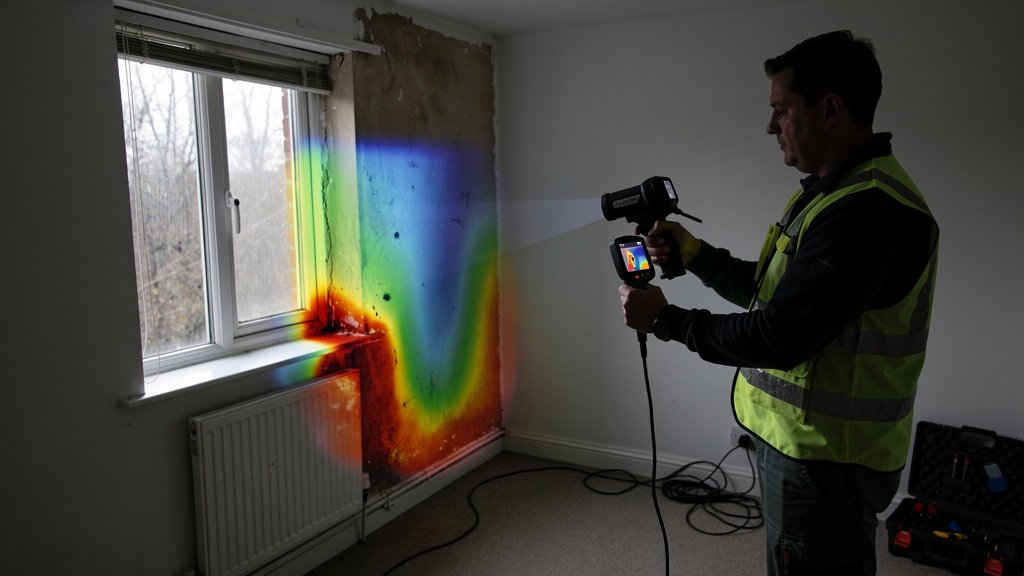
Perhaps the most powerful tool for detecting hidden damp is the thermal imaging (or infrared) camera. These devices detect differences in surface temperature — and because damp areas tend to be cooler than dry areas (as moisture evaporates and absorbs heat), thermal imaging can reveal moisture problems that are invisible to the naked eye.
Thermal imaging is particularly useful for:
- Finding moisture behind wall linings and plasterboard
- Identifying cold bridging (areas of structural thermal weakness that encourage condensation)
- Locating leaks in plumbing or roofing systems
- Mapping the extent of moisture across large wall or floor areas
Thermal images are also powerful visual evidence in a housing disrepair report — they make the invisible visible, in a way that is immediately understandable to non-specialists including judges and juries.
4. Hygrometers and Data Loggers
A hygrometer measures the humidity and temperature of the air in a room. High indoor humidity — particularly in combination with cold surfaces — creates ideal conditions for condensation and mould growth.
In some cases, our surveyors deploy data loggers — small devices that are left in a property for a period of time and continuously record temperature and humidity. This data can be particularly useful in cases where a landlord argues that the damp problem is caused by tenant behaviour rather than structural issues. If the data shows persistently high humidity even at times when the property is unoccupied, it strongly suggests that the building fabric — rather than lifestyle — is the root cause.
5. Visual Dye Testing
In some cases — particularly where the source of penetrating damp is unclear — our surveyors may use dye testing. This involves introducing a visible dye into a suspected source of moisture (such as a drain or downpipe) and then checking inside the building to see where the dye appears. This can definitively identify drainage defects or leaking pipework as the source of a damp problem.
Why These Methods Matter for Housing Disrepair Claims
Using professional tools to detect and document damp is important for two main reasons:
- Accurate diagnosis: Without proper equipment, it's easy to mistake the type of damp or miss its true extent. Misdiagnosis leads to ineffective repairs — and, from a legal perspective, an inaccurate report.
- Evidence quality: Courts and legal representatives expect housing disrepair survey reports to be supported by professional investigation data — moisture readings, thermal images, humidity records. Reports that rely only on visual observations carry less weight than those backed by empirical data.
Our damp and mould inspections include moisture mapping, thermal imaging where appropriate, and full photographic documentation. Every finding is supported by professional measurement data, giving your solicitor the strongest possible evidential base. Book a damp inspection today.